




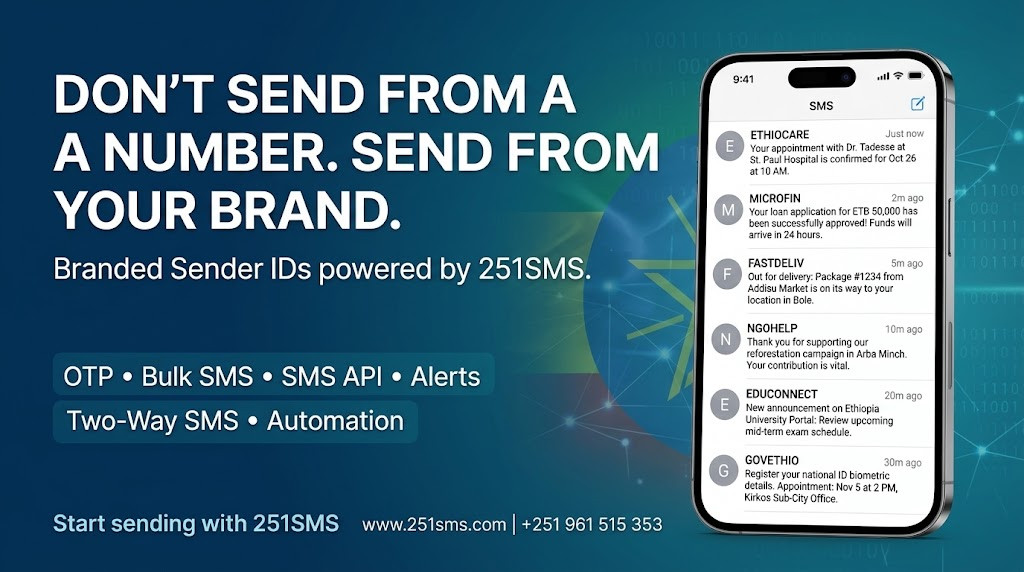
Introduction
If you're sending SMS messages to customers in Ethiopia, understanding local regulations isn't optional—it's essential for successful delivery and legal compliance. Ethiopian telecommunications regulations require specific practices for Sender IDs, content types, and message timing .
This guide covers everything you need to know about SMS compliance, delivery best practices, and how to ensure your messages reach customers reliably.
Sender ID Registration Requirements
Sender ID registration is mandatory for Ethio Telecom networks. Starting October 8, 2026, messages with unregistered Sender IDs to this network will be blocked entirely .
Key Requirements:
Alphanumeric Sender IDs are supported on all networks except Ethio Telecom (63601), where prior registration is required
Sender IDs are case sensitive and must include your brand name
Generic Sender IDs such as INFO, SMS, or NOTICE are prohibited
Registration requires: Sender ID name, content samples, company name, company URL, company address, VAT/TIN, traffic type, and monthly volume
Registration Timeline: Allow approximately 14 days for Sender ID provisioning .
Content Restrictions for SMS in Ethiopia
Understanding what you can and cannot send is critical for compliance and delivery rates.
Allowed Content:
Service-related notifications
Appointment reminders
Order confirmations
Prohibited Content:
Important: Marketing and promotional messages are strictly prohibited without special approval from Ethio Telecom .
SMS Delivery Benchmarks for Ethiopia
Understanding performance metrics helps you monitor and improve your SMS campaigns.
Why Delivery Fails in Ethiopia
Most delivery issues in Ethiopia don't appear clearly in dashboards .
Common Causes:
Indirect routing paths — messages pass through multiple external networks before reaching Ethiopia
Network congestion — especially during peak hours or large-scale campaigns
Filtering rules — applied by operators, particularly for promotional traffic
Sender ID inconsistencies — reduce trust at the network level
Low-quality delivery reports — where "delivered" doesn't reflect actual handset delivery
The Hidden Gap: When a dashboard shows "sent," it usually means the platform accepted the message. When it shows "delivered," it typically means the operator accepted it—not necessarily that it reached the customer's phone .
Best Practices for SMS in Ethiopia
Do's:
Maintain sender brand consistency
Use your organization's name as the Sender ID
Respect message length limits (160 characters for GSM-7 encoding)
Don'ts:
Frequently Asked Questions
Q: Can I send promotional SMS in Ethiopia?
A: No. Only transactional traffic (OTPs, notifications, alerts) is allowed. Promotional and marketing messages are strictly prohibited .
Q: How long does Sender ID registration take?
A: Approximately 14 days for provisioning .
Q: Is two-way SMS supported in Ethiopia?
A: Two-way SMS is not supported. Ethiopia supports only one-way (A2P) messaging .
Q: What happens if I send without a registered Sender ID?
A: Starting October 8, 2026, messages to Ethio Telecom networks will be blocked .
Q: What are the character limits for SMS?
A: 160 characters for GSM-7 encoding. Concatenated messages are supported .
How 251SMS Simplifies Compliance
251SMS takes the complexity out of SMS compliance in Ethiopia:
Sender ID registration handled for you — we manage the entire process with Ethio Telecom
INSA Security Audit compliant — completed Ethiopia's rigorous national security compliance
Direct operator connections — messages routed directly to Ethio Telecom and Safaricom networks
Compliance checking — automatic validation of message content
Local expertise — built specifically for Ethiopia's regulatory environment
Need help with your SMS compliance? Contact us at info@251sms.com or call +251961515353.
Add New Comment